Chapter 6: Sing in harmony
Chapter 6 Introduction
In this chapter, you’ll learn about how to sing in harmony. Even if you don’t plan to be a singer during your professional career, this is still a very useful skill to learn. To sing in harmony, you need to be able to hear your own musical part while singing and listen to the parts of the other singers. The challenge is to listen to both parts without getting off track. As you may imagine, this skill depends as much on your listening ability as it does on your singing ability.
To develop this skill, you’ll start by singing in unison with another singer or group of singers. Then, you’ll practice singing a “drone” or repeating note, while someone else sings a simple melody. Since your part won’t change, you can focus on listening to the simple melody. Then, you’ll practice singing a simple melody while someone else sings a drone. Finally, you’ll practice singing a simple melody in harmony. Depending on your singing experience and level of Aural Skills, this might feel like a huge accomplishment. For some people, singing in harmony is natural, something they did with family or friends growing up, or in church or at a sacred service. For other people, this might be the first time they’ve ever sung in harmony. The purpose of this chapter is to help you use singing in harmony to develop your listening abilities.
Chapter 6 Challenge – performing in ensembles
In professional contexts, performing in ensembles requires strong listening skills. Singing in harmony takes place in choral groups, musical theater, opera, many bands, at sacred and religious services and ceremonies, and many other contexts. Even if you are playing in an instrumental ensemble, developing the ability to sing in harmony still can be helpful. Aural Skills can help you focus your attention anytime that you are listening and creating music at the same time.
Chapter 6 Goals
By the end of this chapter, you should be able to:
- Perform simple canons and duets
- Keep a steady beat while singing in harmony
- Maintain intonation while singing in harmony
Chapter 6 Vocabulary
Canon – In a canon, different voices (or instruments) sing (or play) the same melody, with no changes, but at different times. The melody is usually sung at the same pitch or an octave higher or lower, but there are also canons in which the second part sings or plays the melody a perfect fourth or fifth higher or lower than the first part.
Drone – A drone is a note that changes rarely or not at all. Drones can be most easily found in bagpipes music, Indian Classical music and other musics that use instruments that traditionally play drone notes.
Harmony – As soon as there is more than one pitch sounding at a time, you have harmony. Even if nobody is actually playing chords, or even if the notes are part of independent contrapuntal lines, you can hear the relationship of any notes that happen at the same time, and it is this relationship that makes the harmony.
Definitions adopted from “Understanding Basic Music Theory” by Catherine Schmidt-Jones, 2013. CC-BY
Section 6.1 – Performing with others
In many cases, music is a collaborative and social art. As you prepare to perform with others, you’ll need both musical skills and non-musical skills. This text uses the term “stage partner” to describe someone you are making music with, whether you intend to be on stage with them or not. The musical skills you’ll need include preparing your part, performing in time with others, and maintaining your intonation. The non-musical skills include getting to know your stage partners and being a good stage partner.
Before you sing with your classmates, take a moment to learn their names if you don’t already know them. Introduce yourselves and consider sharing a bit about your interests, musical or otherwise. It will help to know at least a little bit about your stage partners before you start. Take a moment to brainstorm, as a group, what it means to support each other while on stage. Does it mean coming in with your parts prepared? Does it mean offering encouragement when someone struggles? Come up with at least one thing that you can all agree on and write it down.
Example 6.1.1
Listen to a musical example provided by your instructor. Do you hear it as a collection of parts or one ensemble? Or do you hear it as a combination of the two? Explain your reasoning. Then, find a partner and ask them to consider the same questions and explain their reasoning. Have a short discussion about where you agree or disagree. This can also be done in small groups.
Section 6.2 – When mistakes happen
This section focuses on non-musical skills. When you perform in an ensemble, it’s very possible that at least one person will make at least one mistake. It’s not unheard of for mistakes to happen during a performance, even among professionals. Depending on the musical tradition you grew up in, you may have strong feelings towards making mistakes during performance. For some people, it can “ruin” a performance or result in criticism from a teacher, family, or friends. For other people, a mistake is simply something to shrug off, not worth mentioning or worrying about. When learning a new skill, mistakes are expected.
If you make a mistake during the following exercises, take a moment to check in with yourself. If you have strong feelings, acknowledge them and then try and draw your attention back to the task. Apologizing or getting upset with yourself will only be a distraction from the learning process. If someone else makes a mistake, try and be compassionate. Avoid sighing, rolling your eyes, laughing, or making a big deal about it. Instead, try and be curious. There may be something happening that you as a group could fix to help the ensemble sound better. In cases where your stage partner, or teacher tells you that you’ve made a mistake, try listening before getting defensive. If they are being respectful and genuine, it’s likely they’re only trying to help. The industry-standard response to receiving critique is “thank you”. Whether you intend to use the feedback or not, it shows that the person took the time to listen to your performance and form an opinion.
If one of your stage partners treats you disrespectfully, make sure to address it appropriately and without waiting too long.
Section 6.3 – Preparing your part
One way to be a good stage partner is to spend time preparing your part before performance. When singing in harmony, this is especially important. In the examples below, annotate the melodies with the counts and solfege, just like you did in Chapter 4. Then, practice one of the melodies silently in your imagination. Finally, try singing the melody out loud. Once you are confident with your part, ask a stage partner to join you and sing the other part.
You can put the parts together slowly. Start by singing just the first note of your part and having your stage partner sing the first note of their part. Then, try singing your second note while they sing their second note. Take as much time as you need to get the two parts balanced in terms of dynamics and intonation. As you practice, pay attention to the sound you’re producing and to the sound your stage partner is producing. Offering a genuine, focused compliment can help move the process along (ex. “you sang that last note at exactly the right level of dynamics – it really helped our voices blend.”). If you need to offer critique, use the suggestion in the last section and be curious (ex. “I think your part is a little out of tune in measure 3, would it be helpful if we ran through it a few more times?).
The examples below are all unison melodies: you and your stage partner should sing the same part, together. Try and rehearse and perform these so that you and your stage partner(s) sound like one instrument or voice.
Example 6.3.1 – example created by Alex DiCicco, public domain

Example 6.3.2 – example created by Alex DiCicco, public domain

Section 6.4 – Performing in time with others
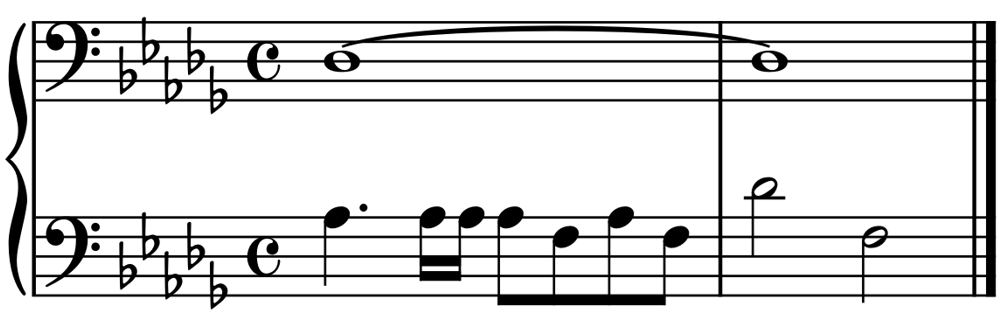
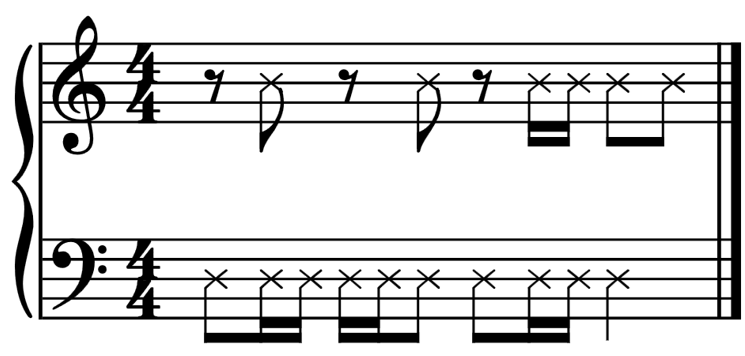
Prepare the following example by annotating it with the counts for both parts. Then, decide who will be responsible for keeping a steady beat while you perform. The person in charge of keeping the beat can use their hands, feet, or body language to communicate. If you feel confident in your conducting skills, feel free to conduct. Practice silently first, getting your own part down. Then, switch to focusing on matching up the rhythmic elements of both parts. You can start very slowly at first, working in small chunks. Take your time and celebrate any successes as you go. Feel free to make up your own lyrics.
Example 6.4.1 – example created by Alex DiCicco, public domain
Section 6.5 – Maintaining intonation
Intonation is the ability to play or sing a note in tune. Having good intonation requires a performer to produce musical sound while also listening. Some instruments often involve learning intonation early on, like the violin, the voice, or the clarinet. Other instruments may involve less focus on intonation, for example the piano or the organ. You may already have excellent intonation while using your voice, or you may be able to hear errors but struggle to correct them, or vice-versa. The examples below will give you the opportunity to practice your intonation.
Start by reviewing the drone and the accompanying melody. Take turns singing each part with your stage partner. When singing the drone, start by listening to your part only. Try and keep the pitch as stable as possible, without going up or down. Once you feel confident, try singing the drone and shifting your listening to the other part. See if you can listen to the other part while keeping your part steady. When singing the melody, start by listening to your part only. Focus on imagining each note before singing it, then landing on the note, and then keeping the pitch steady. Once you feel confident, try and shift your listening to the drone part. Instead of taking one turn on each part, make sure each person has the chance to sing each part multiple times instead of just once.
Example 6.5.1 – example created by Alex DiCicco, public domain
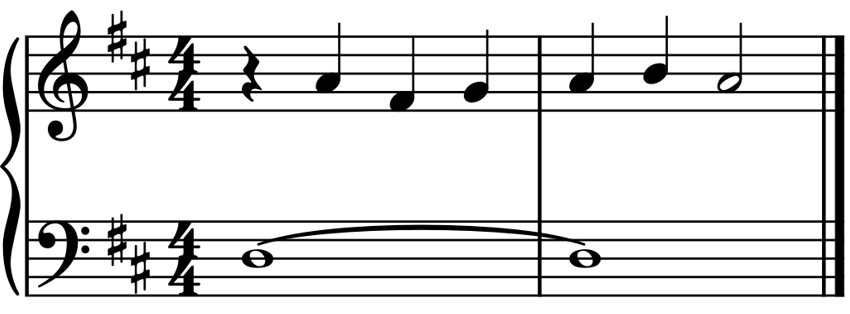
Example 6.5.2 – example created by Alex DiCicco, public domain
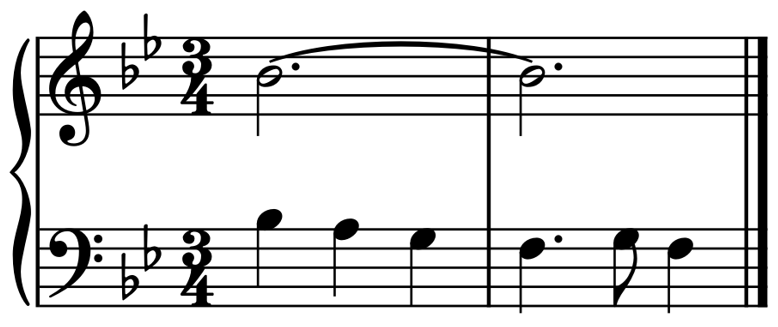
Example 6.5.3 – example created by Alex DiCicco, public domain
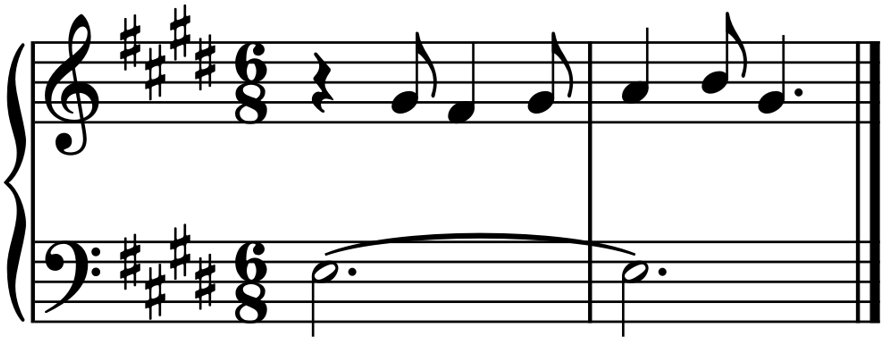
Example 6.5.4 – example created by Alex DiCicco, public domain