Chapter 7: Conduct while sight-singing
Chapter 7 Introduction
In this chapter, you’ll learn how to conduct while sight-singing. The purpose of this task is to help you be able to effectively imagine a piece of music after looking at a musical score. It ties together your ability to read and annotate musical notation, how to imagine musical sound, how to use conducting patterns, how to keep a steady beat, and how to sing while using solfege syllables. While you may not have to conduct while sight-singing during your professional career, you can still benefit from learning to balance multiple complex skills at once.
You will practice this skill by building up each component part individually, then practicing them in pairs. By going slowly, focusing on small chunks, and spreading out the tasks, you’ll help yourself avoid fatigue while also building your confidence. If you get frustrated or stuck, try slowing down. If that doesn’t work, try skipping to the next task and returning to the challenge-spot later. As you go, celebrate successes and offer yourself words of encouragement.
Chapter 7 Challenge – leading an ensemble
Leading an ensemble requires you to integrate and apply many different musical and non-musical skills at the same time. To effectively lead an ensemble, you’ll need to know all the parts and be able to listen and critique them as you’re hearing them. You’ll also need to be able to deal with the individual personalities and abilities of the ensemble members.
Chapter 7 Goals
By the end of this chapter, you should be able to:
- Sing melodies at sight using solfege syllables while conducting
Section 7.1 – Leading an ensemble
Leading an ensemble comes with responsibility. Usually, ensemble leaders are paid more than ensemble members. In addition, they are usually held responsible when things go wrong. In many ensembles, the leader must earn the trust of the other players and will usually be held to a higher standard of musicality and professionalism. In addition to being responsible for the music sounding good, the ensemble leader is also responsible for making sure everyone arrives on time, stays focused, and has what they need. The ensemble leader may have to help resolve disputes, address issues, or answer questions.
The complexity of the task is why most ensemble leaders spend careful time and effort preparing and planning how to use rehearsal time. Having a well-planned and effective rehearsal schedule is one of the biggest tools you can use to manage rehearsals and positively impact the overall outcome of the ensemble. Coming to the first rehearsal with the music prepared and a clear idea of how to use the time will help develop trust between you and the ensemble players. It’s a simple and quick way to show your respect for their time and recognition of their efforts and abilities. A strong rehearsal plan can be the path you and the ensemble members follow towards a shared goal.
A sample rehearsal plan:
- 6:00pm – 6:15pm, warm-ups, questions
- 6:15pm – 6:30pm, review section A with each voice part individually
- 6:30pm – 6:45pm, sing through section A, full group
Section 7.2 – When mistakes happen
While mistakes are undesirable, they are rarely unavoidable. Take time to make a plan for how you will address mistakes before they happen. This can go a long way to keeping the rehearsal process moving along smoothly. Consider how you will respond if you make a mistake as well as how you’ll respond if one of the ensemble members makes a mistake. You’ll also want to think about your response will be if one ensemble member critiques a fellow member or you.
If you have a plan, a mistake won’t disrupt the rehearsal process or use up valuable time. Keep in mind that at the end of the day, musicians are people. Showing kindness and compassion can go a long way towards developing trust and mutual respect. Note that you can be organized and firm while still being kind. It is important to show yourself kindness and compassion as well. Take regular breaks during rehearsals, even if union or venue rules do not require it. Try and be sensitive to issues of temperature, light, and excess noise or interruptions. Addressing these non-musical elements can help you bring out the best performance from the ensemble members.
Section 7.3 – Annotate the score
In this section, you’ll practice the skills needed to prepare an example to sight-sing while conducting. These skills are very similar to how to prepare parts for a rehearsal. In many ensembles, it’s very common for the leader to be called upon to sing or play one the parts. Annotate each example with solfege syllables and counts, then check your work. You can use the space provided, blank staff paper, or music notation software (make sure to keep the volume muted).
Example 7.3.1 – No 5 Op 22 8 Vocalises à 3 voix by Mathilde Marchesi
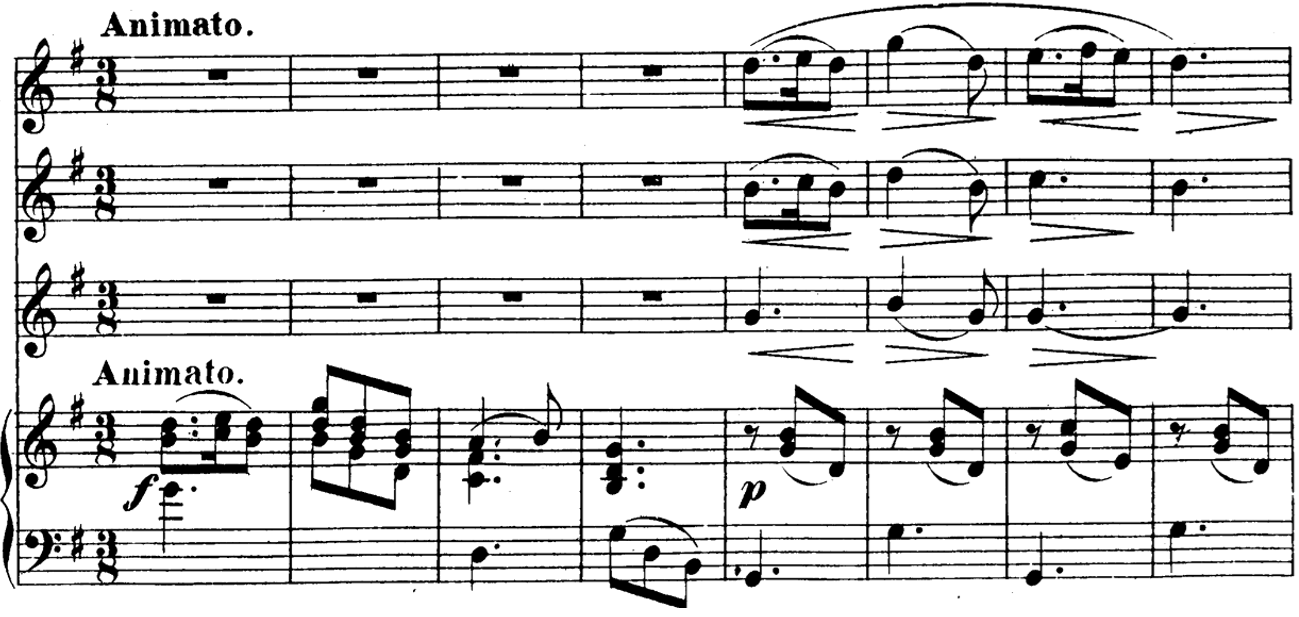
Example 7.3.2 – No 6 Op 22 8 Vocalises à 3 voix by Mathilde Marchesi

Example 7.3.3 – No. 7 Op 22 8 Vocalises à 3 voix by Mathilde Marchesi
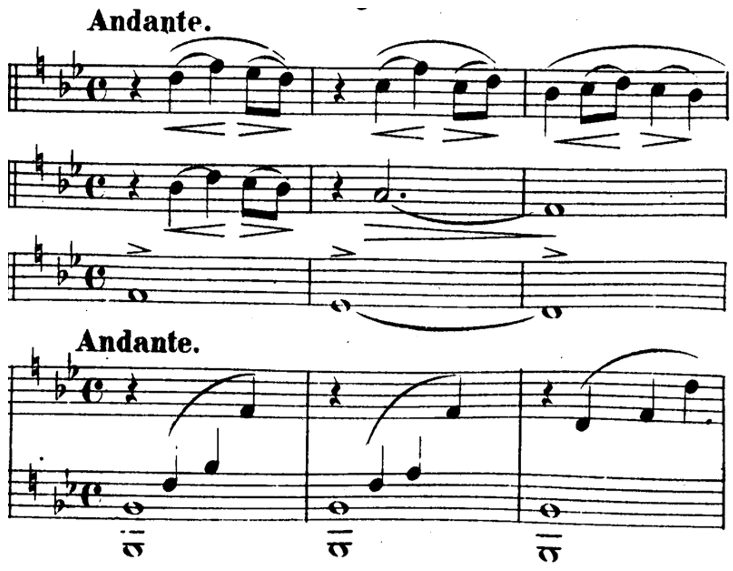
Example 7.3.4 – No. 3 Op 22 8 Vocalises à 3 voix by Mathilde Marchesi
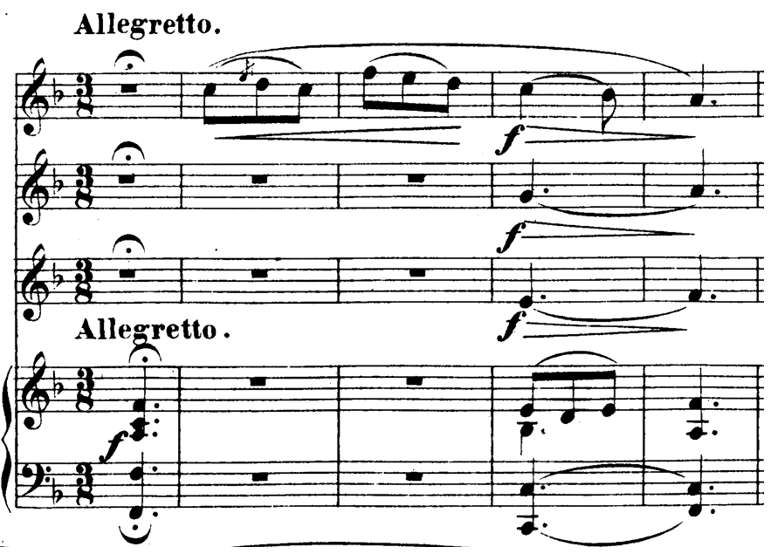
Section 7.4 – Silent practice
Once you have the parts prepared, you can progress to silent practice. Many musicians use silent practice to help them prepare music for performance. You can practice silently anywhere, with or without a musical score. Using examples 7.3.1, 7.3.2, 7.3.3, and 7.3.4, complete the following silent practice steps:
- Start by conducting while following along with the score.
- Then, try conducting while imagining the rhythms.
- Next, try imagining the pitches, sounding them out in your mind’s ear.
- Try conducting while imagining the pitches.
- Without conducting, try imagining pitches and rhythms together.
- Once you feel confident, add the conducting back in.
- Conduct several times, hearing the pitches and rhythms in your head while keeping a steady beat.
Section 7.5 – Putting it all together
Now that you’ve silently practiced each of the component parts, you’ll move on to practicing sight-singing while conducting. You’ll be using excerpts from the previous examples. Try using a slower tempo than the one you used for silent practice. Using examples 7.3.1, 7.3.2, 7.3.3, and 7.3.4, complete the following steps:
- Conduct while following along with the score, tapping or speaking the rhythms softly.
- Then, sing the pitches softly (“under your breath” or sotta voce) in rhythm over and over, gradually adding in the conducting. Go slowly, taking time to sound out each pitch and get each rhythm correct.
- Once you feel confident, conduct while singing with your full voice.
In this chapter, you practiced sight-singing while conducting by breaking the task down into three parts: annotating the score, practicing silently, and putting the pieces together. Each of those larger parts had many smaller steps. The chapters leading up to this chapter were opportunities to practice those smaller steps and build up your prerequisite knowledge. For example, to sight-sing, you need to know how to read music in any clef and any key. You also need to be able to identify the meter and decipher rhythms. Move on to the next part of this resource and challenge yourself to sight-sing the examples within. Remember to go slowly and break larger tasks into smaller parts. As the old saying goes, slow practice makes fast progress.