Chapter 1: Listen and respond to music
Chapter 1 Introduction
Questions to consider:
- How do you typically react when you hear new music?
- Do you quickly form an emotional response?
- Do you analyze the quality of the recording or the skill of the performer?
- Do you want to start playing along or start taking notes on paper or your device?
Maybe you have multiple responses. Think about your typical response to new music. Then, think about how you would communicate that response to another musician. What words would you use?
Chapter 1 Challenge – communicating with professional musicians
In this chapter, the challenge you will be focusing on is how to talk about music with other musicians. Since professional musicians have a technical vocabulary for describing music, you’ll need to know how to focus your listening and how to use specific terminology.
Chapter 1 Goals
By the end of this chapter, you should be able to:
- Focus your attention on what you’re hearing
- Transcribe contour for simple melodies from dictation
- Transcribe pulse and accents for simple rhythms from dictation
- Review your notes silently
Chapter 1 Vocabulary
Beat (also called “pulse”) – Because music is heard over a period of time, one of the main ways music is organized is by dividing that time up into short periods called beats. In most music, things tend to happen right at the beginning of each beat. This makes the beat easy to hear and feel. When you clap your hands, tap your toes, or dance, you are moving to the beat.
Contour – As a melody progresses, the pitches may go up or down slowly or quickly. You can picture contour as a line that goes up steeply when the melody suddenly jumps to a much higher note, or that goes down slowly when the melody gently falls. Such a line gives the contour or shape of the melodic line. You can often get a good idea of the contour of this line by looking at the melody as it is written on the staff, but you can also hear it as you listen to the music.
Dynamics -The loudness or softness of musical sound. Dynamic symbols range from soft to loud. Much of the time, the following Italian terms are used (from very soft to very loud): pianissimo, piano, mezzo piano, mezzo forte, forte, fortissimo. Dynamics can also include gradual changes in loudness of softness. Italian terms for gradual changes include crescendo (play gradually louder) and decrescendo (play gradually softer).
Timbre (pronounced “TAM-ber”) – The color or quality of sound that distinguishes one instrument or voice from another. Timbre is caused by the fact that each note from a musical instrument is a complex wave containing more than one frequency. Small differences in the balance of the frequencies – how many you can hear, their relationship to the fundamental pitch, and how loud they are compared to each other – create the many different musical colors, or timbre. In other words, if a flute plays a note, and then an oboe plays the same note, for the same length of time, at the same loudness, you can still easily distinguish between the two sounds, because a flute sounds different from an oboe. This difference is in the timbre of the sounds.
Definitions adopted from “Understanding Basic Music Theory” by Catherine Schmidt-Jones, 2013. CC-BY
Section 1.1 – Listen, then write
One way to focus your listening is to draw your attention to specific elements of musical sound. In this section, you’re going to listen first, then write. While listening, try asking yourself questions: what instruments am I hearing? What do those instruments sound like? How loud or soft is the music? How fast or slow is the tempo? Which elements of the music are staying the same? Which are changing over time? After listening, write down the answers.
In this section, you’ll practice focusing your listening on timbre and dynamics. Start by reviewing the vocabulary above. Then, read through each example below. Example 1.1.1 has been completed for you with sample observations.
Example 1.1.1 – “The Deserted Garden” by Florence Price
Listen to an audio recording of the first 60 seconds of “The Deserted Garden” by Florence Price. You can search for the recording or use a recording provided by your instructor. Focus your listening by asking yourself questions. Then, read the sample observations provided. Do you agree with the sample observations? Why or why not? What would you add or change?
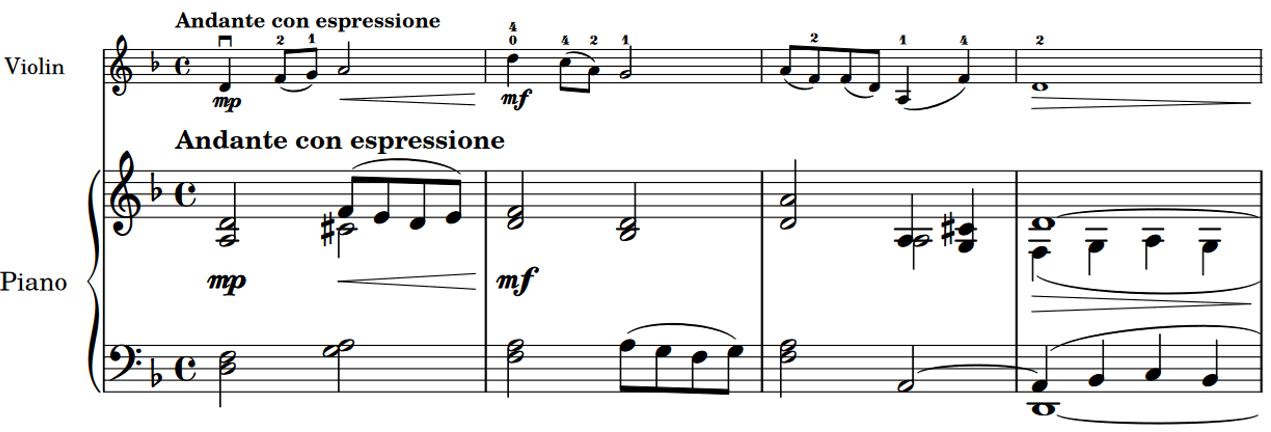
Sample observations
- Timbre: mellow and resonant violin, some vibrato
- Dynamics: mostly soft with some changes
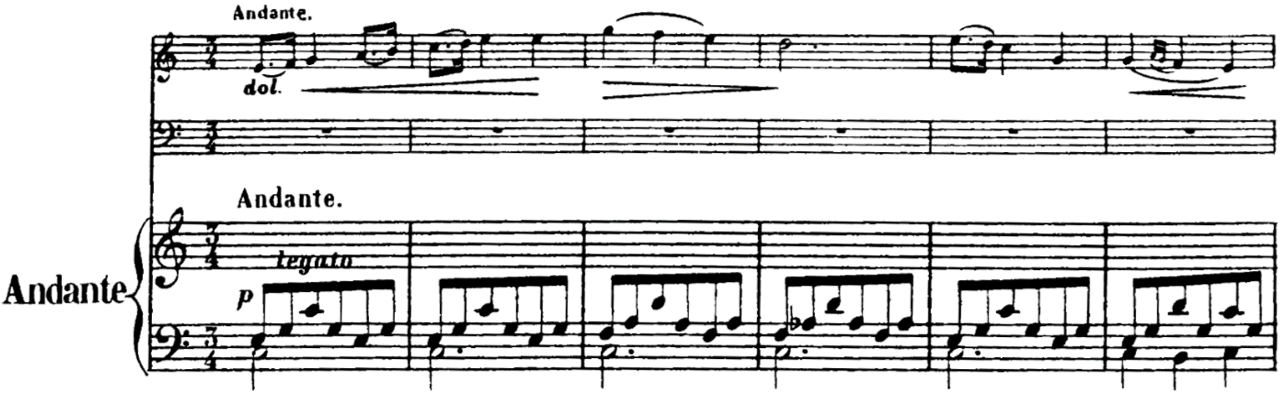
Example 1.1.2 – “Trio for Flute, Cello, and Piano, op 45” by Louise Farrenc
Listen to the first 2 minutes of “Trio for Flute, Cello, and Piano” (Opus 45) by Louise Farrenc. You can search for a recording or use a recording provided by your instructor. Ask yourself questions while you are listening. For example: What instruments am I hearing? What do those instruments sound like? Then, make note of your observations. Listen to the recording at least three times.
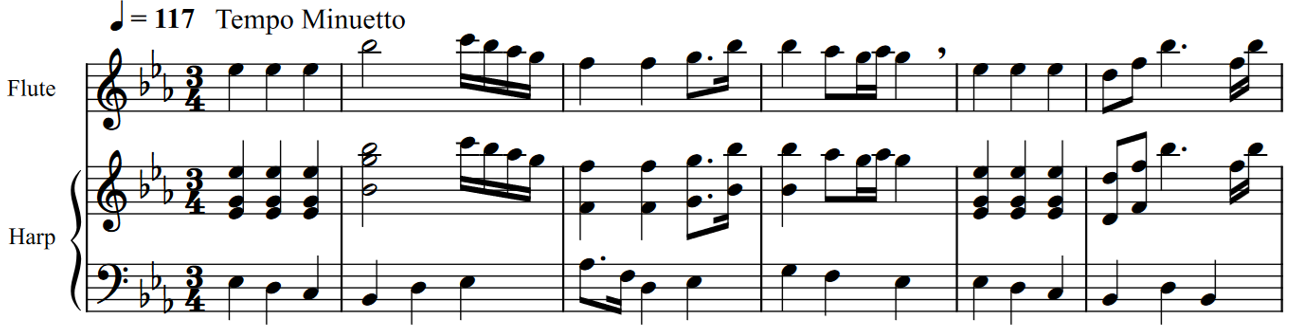
Example 1.1.3 – : “Sonata for Flute and Harp” by Joseph Bologne
Listen to the first 60 seconds of “Sonata for Flute and Harp” by Joseph Bologne. You can search for a recording or listen to a recording provided by your instructor. Ask yourself questions while you are listening. For example: What instruments am I hearing? How loud or soft is the music? Then, make note of your observations. Listen to the recording at least three times.
Section 1.2 – Write while listening
Another way to focus your listening is to notate what you’re hearing using symbols or pictures. This could be marks, lines, or anything else that helps you capture what you’re hearing. It’s not important that you get everything perfect. The skill you are developing is writing while listening. Eventually, you will go from sketching contour to transcribing pitch and from notating beat to writing rhythms. To get there, you’ll start by sketching the melodic contour and making marks to notate the beat. As you listen, try and connect what you’re hearing with what you see on the page.
Example 1.2.1 – “Elite Syncopations” by Scott Joplin
Listen to a recording of the first 15-20 seconds of “Elite Syncopations” by Scott Joplin. You can search for a recording or listen to a recording provided by your instructor.
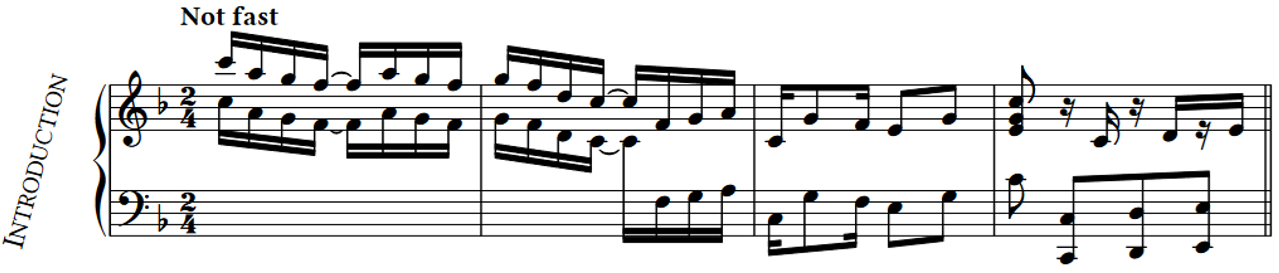
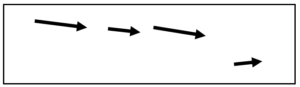
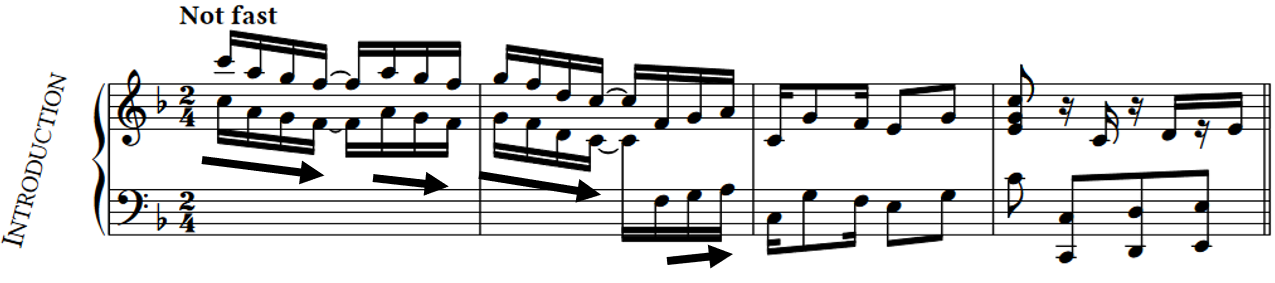
The line below shows contour, or shape of the melody, played during the first two measures of the introduction. The drawing is not meant to be exact, more of an approximation of what you’re hearing. The melody descends, descends again from a higher note, then one more time from a higher note before ascending.
Here’s the same contour drawn on the music notation:
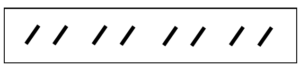
The hash marks below show the beat for the first four measures. You can find the beat by letting your hand or foot tap along with the music. Listening to the left hand (lower sounding) piano part in this piece can also help you find the beat.
Here are the same hash marks written above the music notation: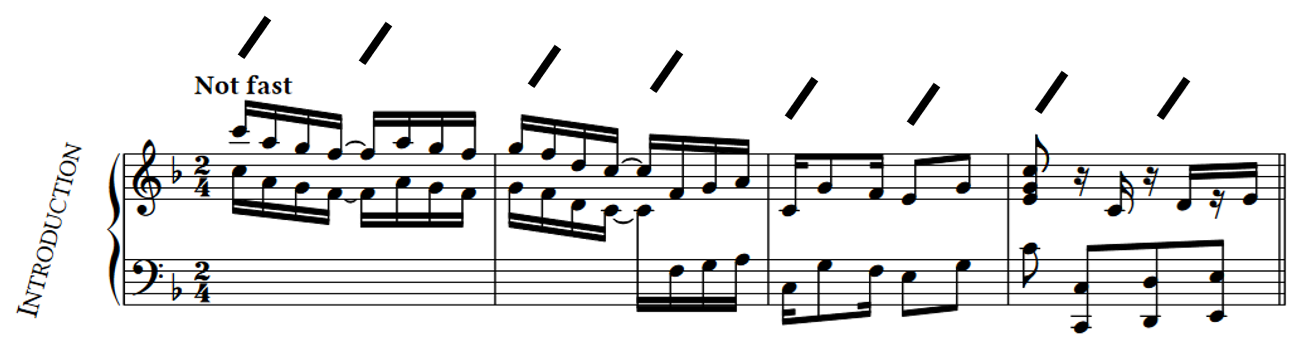
Example 1.2.2 – “Liebeszauber” Op 13 by Clara Schumann
Listen to a recording of “Liebeszauber” Op 13 by Clara Schumann. You can search for a recording or listen to one chosen by your instructor.
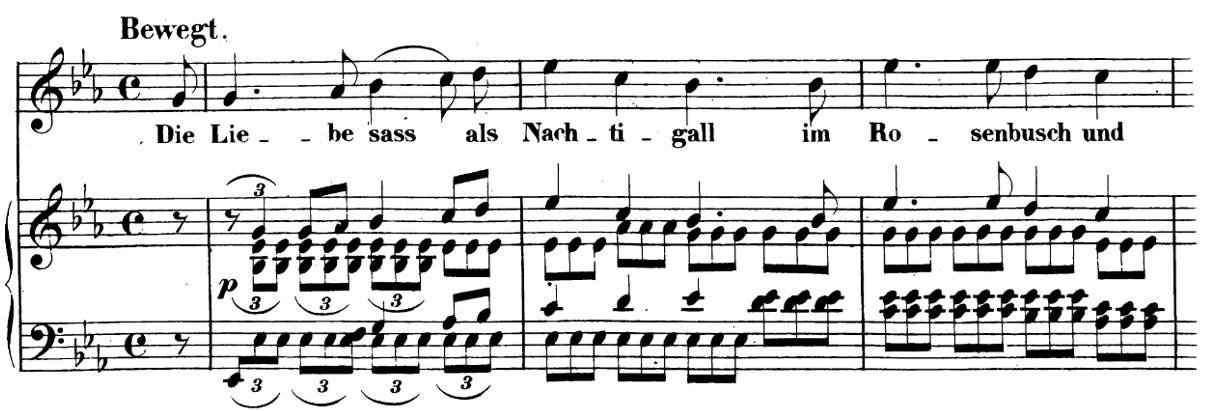
Draw a rough sketch of the shape or contour of the melody, sung by the vocalist. Can you hear the melody getting higher and lower in pitch? If so, can you draw the shape of those ups and downs? Next, listen to the recording again and rewrite your contour on top of the music notation or on a separate piece of paper or using a drawing app.
Draw hash marks for the pulse of the beat, heard in the piano part. Can you feel a steady pulse? If so, how many pulses are you hearing? How fast or slow are they? Next, listen to the recording again and draw hash marks for the beat on top of the music notation or on a separate piece of paper or using a drawing app.
Example 1.2.3 – “Fantasy in Purple” by Florence Price
Listen to a recording of “Fantasy in Purple” by Florence Price. You can search for a recording or listen to one chosen by your instructor.
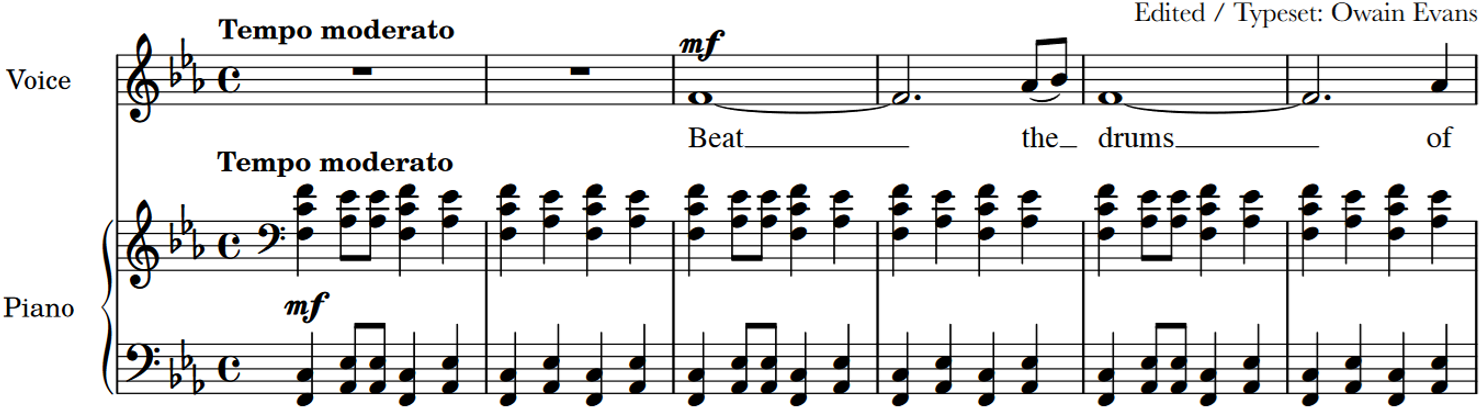
Draw a sketch of the shape or contour of the melody, heard in the vocal part. Next, listen to the recording again and sketch the contour on top the music notation or on a separate piece of paper or using a drawing app.
Draw a sketch of the pulse, heard in the piano part. Next, listen to the recording again and draw hash marks for the beat on top the music notation or on a separate piece of paper or using a drawing app.
Section 1.3 Imagine music
In this section, you’re going to practice imagining music in your mind. When we think about how something will look, we use visualization. When we think about how something will sound, we use audiation. Audiation is the foundation of sight-singing and sight-reading. It can help you use musical scores more effectively and it can also help you create and notate your own music.
In this chapter, you started by focusing your listening, then writing down what you heard using words. Next, you sketched the shape of melodies and the number of beats. In this section, you’re going to start by choosing a music sound. Then, you’re going to write about how you tried imagining it in your mind’s ear. Finally, you’re going to reflect on how it went. This three step process is shown below:
- Musical sound: “I’m going to imagine the sound of a person striking hand cymbals in a huge concert hall”
- Imagination/audiation: “I sit in the library and spend 30 seconds focusing my imagination on the sound. In my mind’s ear, I heard a big clash followed by a decrescendo”
- Reflection: “The library was quiet so it wasn’t hard to focus my listening. I imagined mostly dynamics, not timbre or pitch”
Now that you’ve seen an illustration of the process, try it on your own.
Example 1.3.1
- Choose a musical sound:
- Describe where and how you imagined/audiated that sound:
- Reflect on how it went:
Dynamics
Take a moment to review what you already know about musical dynamics, the terms used to indicate how loud or soft to play a passage. Then, check your knowledge using the activity below: